1Input: an unsigned distance field
We follow the UDF of the Stanford bunny through the pipeline. The slice shows the distance to the surface with iso-lines.
0far
UDF Mesh Reconstruction via Offset-Volume Medial Axis Extraction
ICube, Université de Strasbourg, CNRS, France
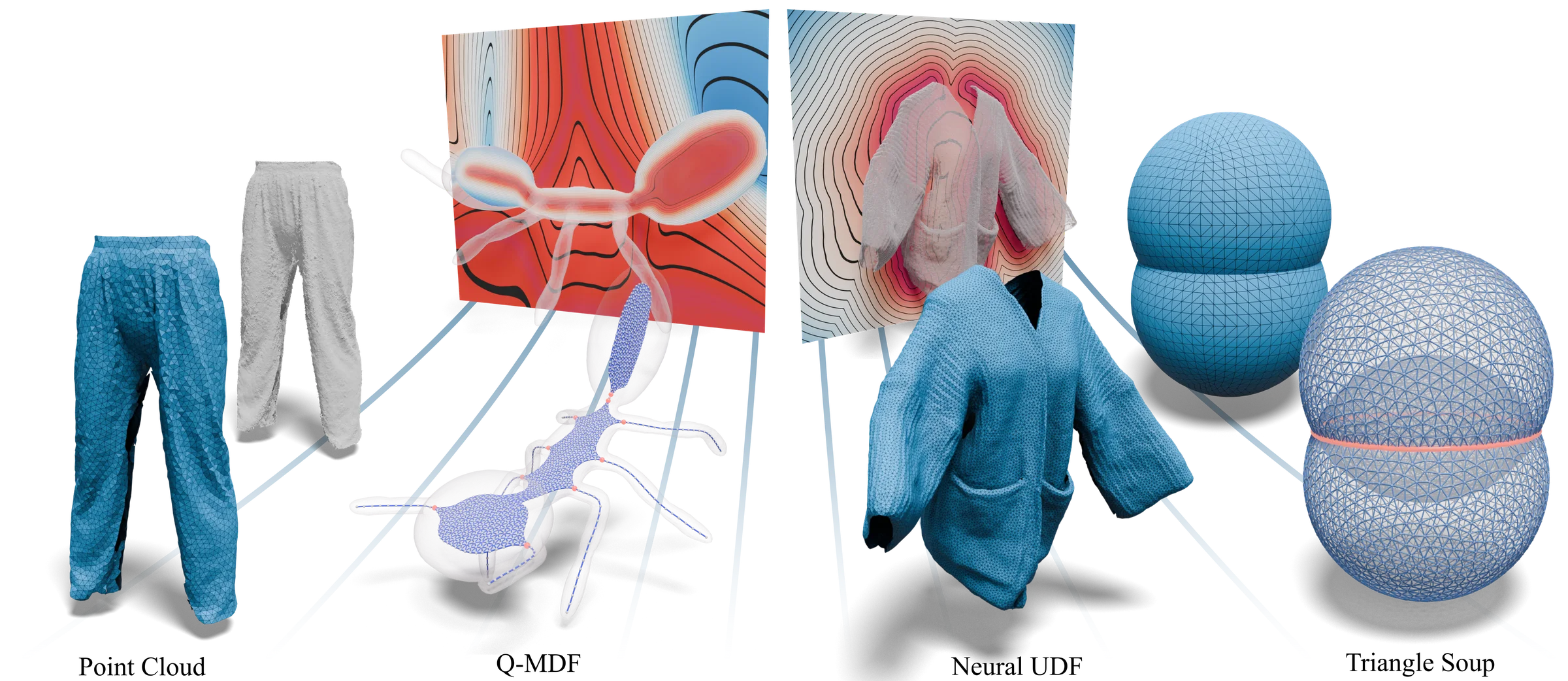
Unsigned distance fields (UDFs) offer broader modeling capabilities than signed distance fields (SDFs), enabling the representation of shapes with open boundaries, non-manifold structures or mixed curve and surface parts. However, extracting coherent meshes from UDFs is fundamentally harder, as classical grid-based iso-surfacing techniques are not applicable since they require a way to distinguish the inside from the outside of the shape. We introduce OffsetAxis, a new UDF reconstruction pipeline that supports open, non-manifold, and curve-like geometries. Our key insight is that the 0-level set extraction problem can be restated as the extraction of the medial axis of the α-offset volume of the UDF. This formulation unlocks mature medial-axis machinery that naturally supports boundaries, non-manifold junctions and curves. To avoid the biases of grid-based techniques, we sample the α-offset surface using ray casting and optimize medial balls inside the offset volume with an efficient variant of Variational Medial Axis Sampling. The final mesh is recovered by taking the dual of the connectivity of the medial ball clusters, producing structurally coherent reconstructions for a wide range of topologies. The robustness and versatility of the approach allow it to handle imperfect distance fields, including neural UDFs trained on noisy inputs, the Quasi-Medial Distance Field (Q-MDF), as well as distances computed directly on triangle soups or point clouds. Extensive experiments demonstrate that our method produces more faithful mesh reconstruction and better alignment with the underlying shape structure than prior techniques.
Six steps, from a distance field to a mesh, on the Stanford bunny. Click a step; drag the 3D view to orbit, scroll to zoom.
We follow the UDF of the Stanford bunny through the pipeline. The slice shows the distance to the surface with iso-lines.
A non-manifold input has no inside/outside.
But its α-offset volume {UDF ≤ α} is always a closed, manifold solid (the cyan line on the slice).
Its medial axis could recovers the topologies of the input if α is smaller than the weak feature size.
Rays stop where UDF = α and leave seeds on both sides of the shape [Ling et al. 2025]. Poisson disk sampling then spreads from the seeds over the whole level set.
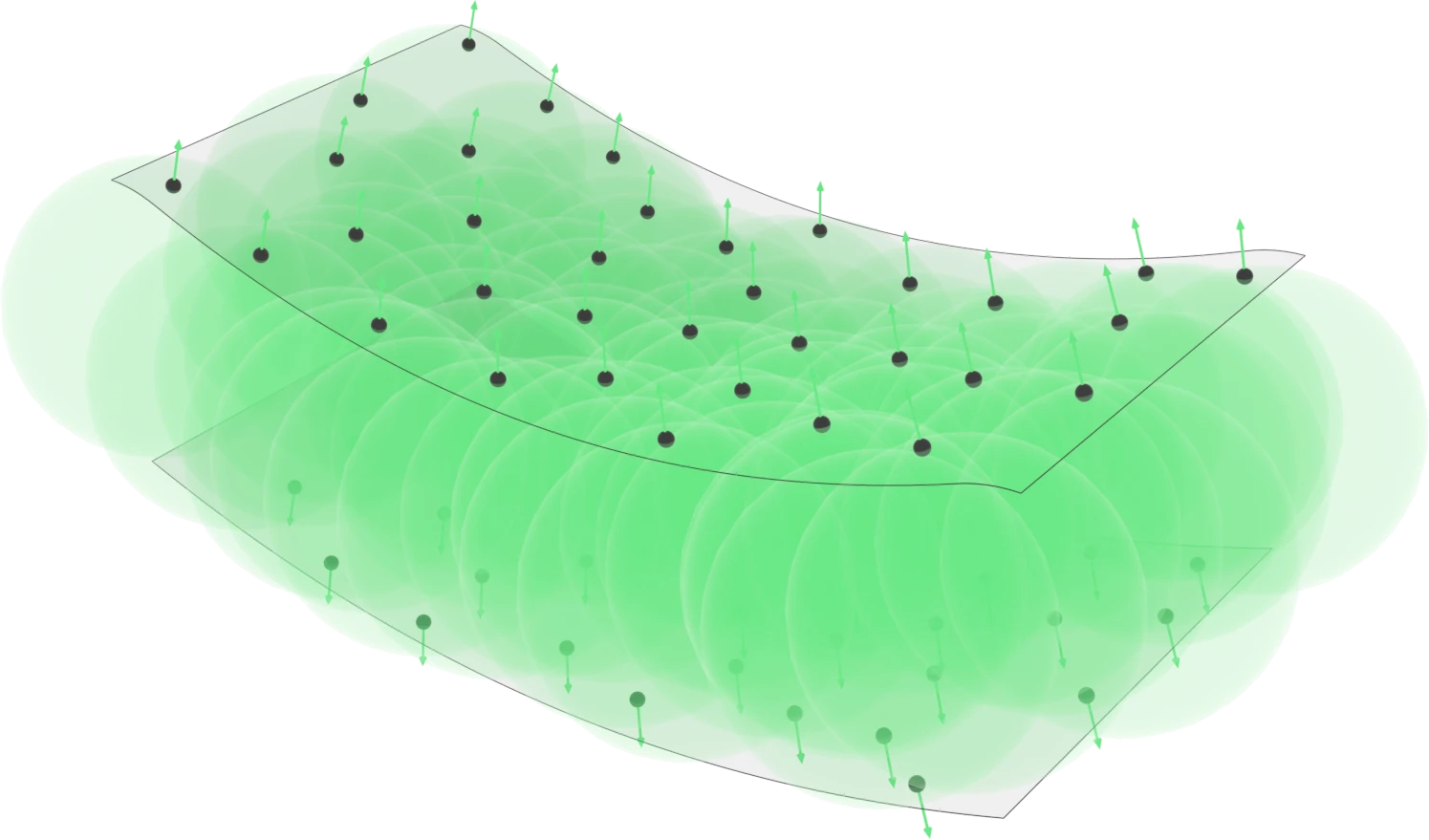
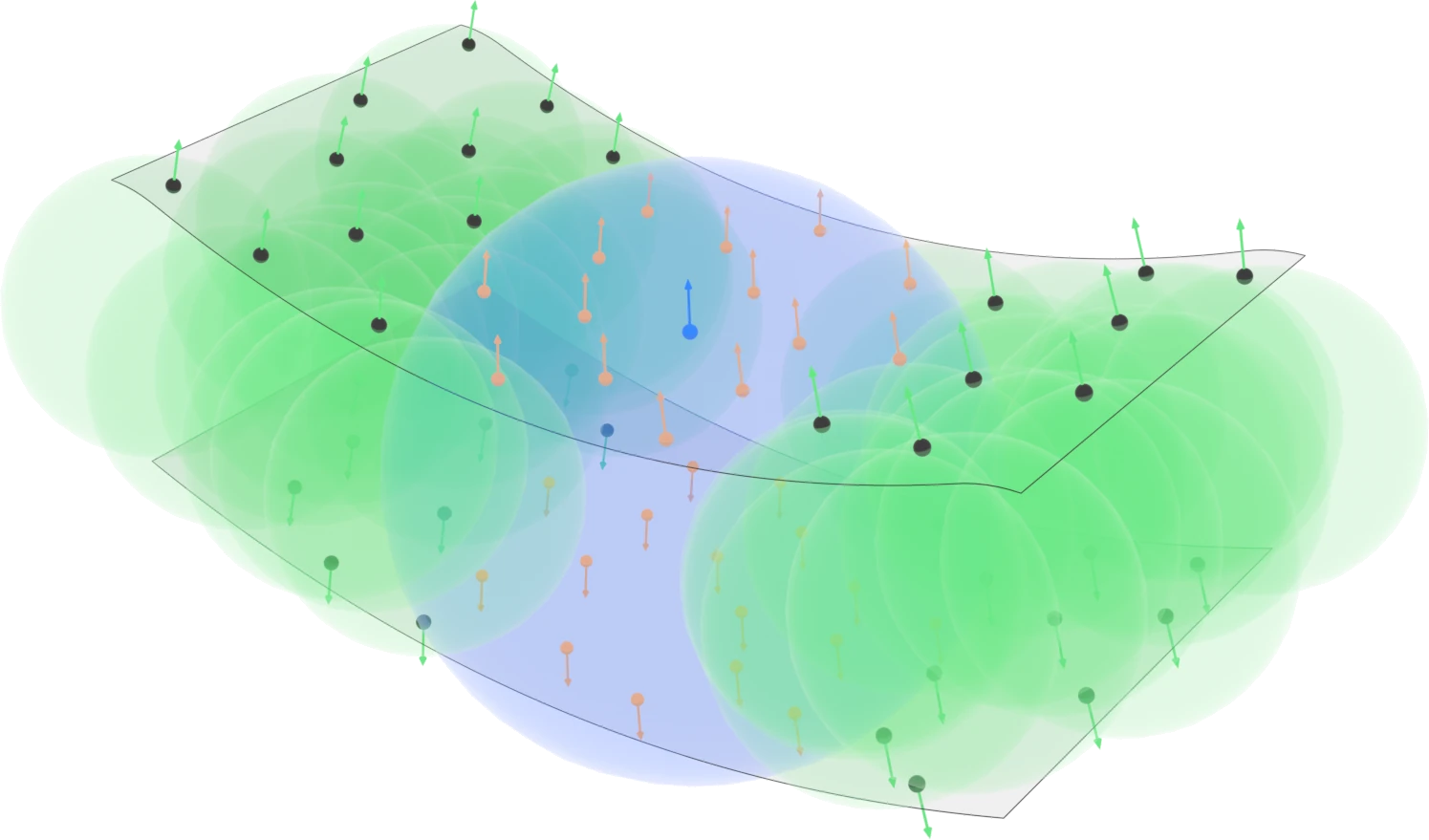
Each sample gets its maximal ball inside the offset volume [Ma et al. 2012]. A greedy cover keeps the largest sphere, drops the samples it covers and repeats [Dou et al. 2022].
We alternate two steps: assign each sample to its best sphere, then update each sphere. The SQEM Q [Thiery et al. 2013] plus a line quadric L [Liu et al. 2025] keep the update quadratic: one linear solve per sphere.
Sphere centres become vertices; two spheres are linked when neighbouring samples belong to them. Triangles are 3-cliques; the few tetrahedra left (orange) are removed by thinning procedure inspired by [Wang et al. 2025].
The output has only triangles and segments.
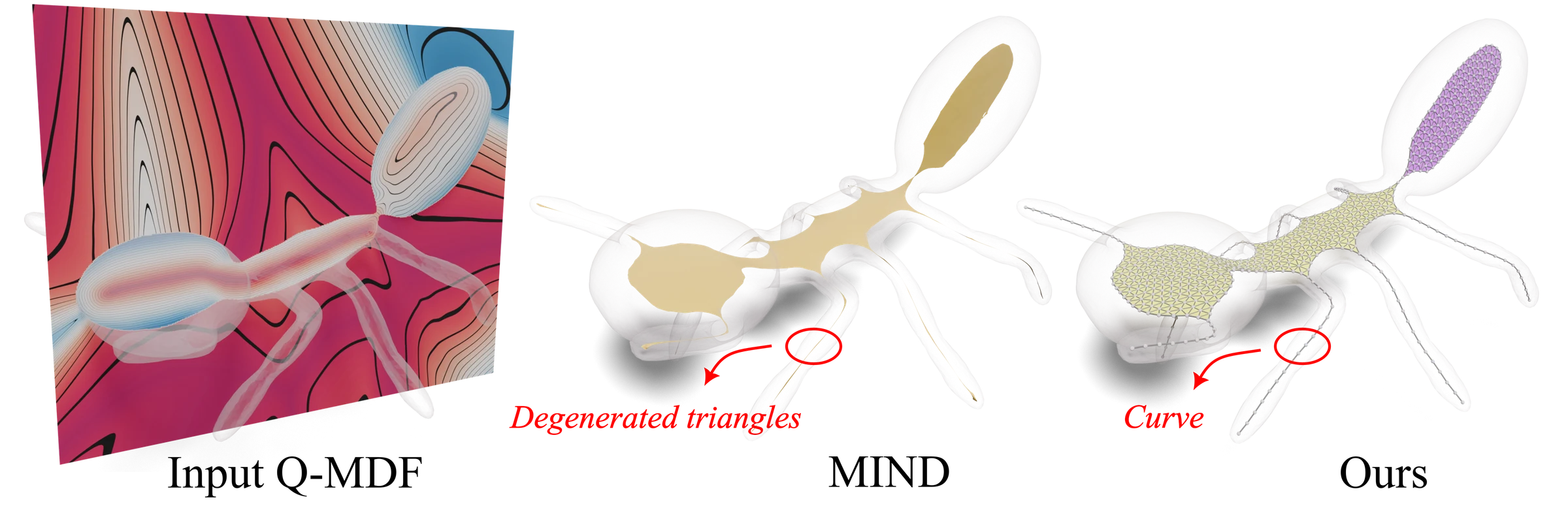
Drag the divider to compare with prior UDF meshing methods; pick another method below.
@inproceedings{huang2026offsetaxis,
  title     = {OffsetAxis: UDF Mesh Reconstruction via Offset-Volume
               Medial Axis Extraction},
  author    = {Huang, Qijia and Kraemer, Pierre and Bechmann, Dominique},
  booktitle = {SIGGRAPH Asia 2026 Conference Papers},
  year      = {2026},
  doi       = {10.1145/3829340.3842256}
}